
Executive Summary
In 2025, the digital asset management landscape is characterized by a rapid convergence of traditional finance (TradFi) and decentralized finance (DeFi). The era of siloed “crypto” and “fiat” operations is ending, replaced by a demand for unified treasury ecosystems. Institutions and corporations are moving beyond simple speculation to utilize digital assets for operational efficiency, real-time settlement, and yield generation. While solution maturity has improved significantly — driven by advancements in Multi-Party Computation (MPC) security and clearer regulatory frameworks like MiCA — the market remains fragmented. The next generation of solutions must solve the “bridge” problem: offering seamless, compliant, and instant interoperability between sovereign currencies and digital assets without the friction of legacy banking rails.
Market Overview: The 2025 Landscape
The digital asset market has transitioned from niche adoption to institutional integration.
- User Base: Global cryptocurrency users have surpassed 580 million, up from 562 million in 2024.
- Institutional Adoption: Approximately 55% of traditional hedge funds now have exposure to digital assets, a significant increase from 47% the previous year. Furthermore, 74% of institutional investors planned to increase their exposure in 2025.
- Corporate Treasury: Public companies are projected to allocate up to $330 billion to Bitcoin over the next five years. Stablecoins have become a critical liquidity tool, with the market projected to reach $500–750 billion by JPMorgan.
- Treasury Evolution: Corporate portfolios are evolving from static cash repositories to dynamic ecosystems blending fiat, bonds, and tokenized assets (e.g., tokenized U.S. Treasury bills yielding ~5%).
Current Solution Categories
1. Unified Fiat-Crypto Platforms
These platforms represent the cutting edge in 2025, aiming to remove the distinction between asset types for the end user.
- Episode Six + Fireblocks: A partnership delivering a programmable platform that integrates fiat, stablecoins, and loyalty points, enabling banks to operate across asset classes on a single infrastructure.
- Deblock: A French-regulated platform offering a unified Euro current account combined with a self-custody crypto wallet, allowing users to spend both seamlessly.
- TrustLinq: A Swiss-regulated crypto-to-fiat payment platform allowing users to pay third parties in fiat directly from their crypto holdings without the recipient needing a crypto wallet.
- TransFi: A unified gateway for the US and UK markets, handling regulatory compliance (KYB) to allow businesses to accept both USD/GBP and digital assets via a single checkout.
2. Institutional Custody & Treasury
Solutions designed for high-security, high-volume corporate needs.
- Fireblocks: The industry standard for MPC-based custody, used by banks and fintechs for treasury, trading, and policy controls.
- Coinbase Prime: A fully regulated U.S. financial custodian serving large institutions with integrated trading and prime brokerage.
- Gemini Custody: Offers segregated accounts with hardware security modules (HSMs) and insurance coverage.
- IBM Digital Asset Haven: A platform for secure, policy-driven keys and transaction management, designed for institutions requiring “hot,” “warm,” and “cold” tiers.
3. Wallet Infrastructure (Custodial vs. Non-Custodial)
Non-Custodial (Self-Custody):
- Hardware: Ledger Nano S Plus, Trezor Safe 7, and Tangem (innovative card-based hardware wallet).
- Software: Best Wallet and RockWallet (features built-in fiat on-ramps).
Custodial:
- Exchange wallets (Binance, Kraken) offer convenience but carry counterparty risk.
- Luno and similar services provide beginner-friendly, bank-like experiences.
4. Portfolio Tracking & Analytics
- CoinStats: Integrates 1,000+ exchanges and wallets for a unified view.
- Nansen: Provides on-chain analytics to monitor token flows and market trends.
Comparative Analysis: Pros & Cons
Custodial Solutions (Exchanges & Prime Brokers)
- Pros: High convenience, integrated liquidity for trading, built-in fiat on/off ramps, customer support, insurance (in some cases like Gemini).
- Cons: Counterparty risk (insolvency/hacks), regulatory friction (frozen funds), lack of true ownership (“Not your keys, not your coins”).
Non-Custodial / Self-Custody
- Pros: Absolute control over assets, censorship resistance, elimination of counterparty risk, privacy.
- Cons: High responsibility (lost keys = lost funds), poor UX for fiat conversion, technical complexity for average users.
Unified Hybrid Platforms (Next-Gen)
- Pros: Seamless spending of crypto as fiat, “banking-grade” compliance, simplified treasury management, real-time settlement.
- Cons: Reliance on banking partners (rails can be cut off), varying regulatory availability by region (e.g., available in EU/Swiss but harder in US).
Key Challenges in Current Solutions
Despite the advancements, builders of next-gen solutions must address significant friction points:
- Fragmentation: Users still often require a bank account, a crypto exchange account, and a self-custody wallet to manage their financial life. Moving value between these silos is slow (T+1 to T+3 settlement) and costly.
- Fiat-Crypto Interoperability: While “on-ramps” exist, true bi-directional flow is often blocked by risk-averse banking partners. The “off-ramp” experience is frequently cited as a major barrier (38% of potential users cite difficulties buying/selling as a barrier).
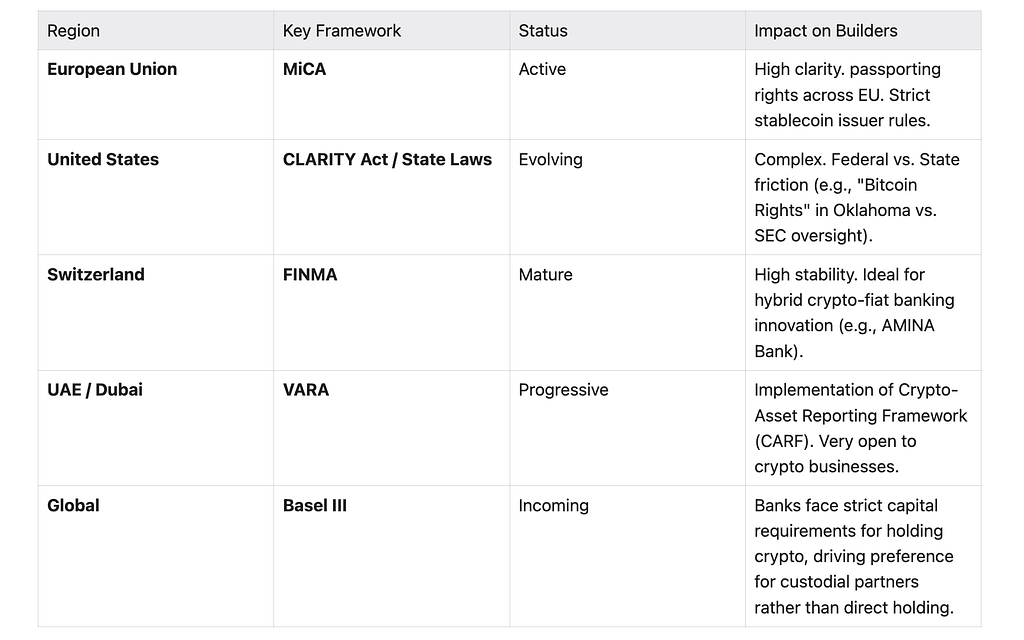
- Compliance Burden: Navigating diverse regulatory regimes (MiCA in Europe, state-level rules in the US, VARA in Dubai) requires complex, dynamic compliance infrastructure that many current platforms lack.
- Custody Risk Trade-off: Institutions want the security of cold storage with the liquidity of hot wallets. Current solutions often force a choice between safety (delayed access) and utility (risk of theft).
- Legacy Infrastructure: Traditional banking rails (SWIFT, ACH) operate on limited hours and slow settlement cycles, bottling the efficiency of 24/7 blockchain networks.
Emerging Trends 2025
1. Payment-versus-Payment (PvP) Settlement
Major trials, such as the Citi and Swift collaboration, have proven the feasibility of settling payments between fiat and digital currencies in a PvP workflow. This reduces settlement risk and bridges the gap between DLT networks and traditional financial systems.
2. Institutional-Grade MPC
Multi-Party Computation (MPC) has become the standard for security. By splitting private keys into shares distributed across different devices/servers, MPC eliminates the “single point of failure” of private keys without the usability hurdles of multisig.
3. Tokenization of Real-World Assets (RWA)
Treasury departments are increasingly holding tokenized U.S. Treasury bills and other yield-bearing real-world assets. Platforms allowing “intraday sweeps” between stablecoins (for working capital) and tokenized T-bills (for yield) are redefining corporate finance.
4. Regulatory Standardization
- EU: MiCA (Markets in Crypto-Assets) provides a clear operating framework.
- US: The proposed CLARITY Act and Responsible Financial Innovation Act of 2025 are moving the US toward regulatory clarity.
- Accounting: FASB’s 2025 update allows companies to mark crypto assets at fair value, encouraging corporate adoption.
Opportunities for Next-Gen Solutions
For a new entrant building a digital asset management solution, the following areas represent high-value opportunities:
1. The “Compliance-by-Design” Layer
Build infrastructure where compliance (KYC, AML, Travel Rule) is embedded at the protocol or smart contract layer. This allows for permissioned pools of liquidity that institutional investors can access without fear of regulatory backlash.
- Model: Automate tax reporting (Form 1099-DA) and real-time audit trails.
2. Seamless “Spend-Anywhere” Liquidity
Create a non-custodial wallet that integrates directly with a debit card issuer or real-time payment rail (like SEPA Instant or FedNow).
- Goal: Allow a user to hold Bitcoin or Stablecoins and swipe a card at a grocery store with instant, background conversion, similar to Deblock or TrustLinq.
3. Hybrid Custody Models
Offer a “Smart Vault” solution that utilizes MPC to give the user self-custody rights (unseizable) while allowing the platform to co-sign transactions for recovery and fraud prevention. This bridges the gap between security and user experience.
4. Unified Corporate Treasury Dashboard
A B2B platform that views Fiat accounts, Stablecoin wallets, and Tokenized Treasuries in a single view, with automated rules for liquidity management (e.g., “Keep $100k in Fiat for payroll, auto-sweep excess into 5% yield Tokenized T-Bills”).
Technical Infrastructure Considerations
- Wallet Architecture: Move away from simple hot/cold wallets to MPC (Multi-Party Computation) wallets. This allows for policy engines (e.g., “Transaction >$10k requires CFO approval”).
- Ledger Integration: The system must run a double-entry ledger that can reconcile blockchain transactions (6+ confirmations) with banking transactions (pending/settled) in real-time.
- Chain Agnosticism: Support for cross-chain interoperability (Layer 0 protocols like Polkadot or CCIP) is essential. Users shouldn’t need to know which chain their USDC is on.
- API-First Approach: Utilize providers like SDK.finance or Fireblocks for the heavy lifting of ledger management and connectivity, focusing development resources on the unique UX and logic layer.
Regulatory Landscape Summary (2025)